I am a member of Prairie Circle Unitarian Universalist Congregation (PCUUC) in Grayslake, Illinois. Our church does not have a full time pastor and is mostly run by members. Guest ministers, members, and friends of the congregation deliver sermons. We rent space for services in a barn and hold on-line services. I had the privilege of delivering our service on Sunday May 29, 2022, during Memorial Day weekend. If you are a reader of my blog, I reframed material from my 2020 post, because my feelings about the death of Sean Maher continue to be an enduring source of sadness and a lasting reminder about the importance of citizenship. If you would like to learn more about our congregation, visit www.prairiecircleuuc.org/aboutus. Here are the readings and the “sermon” that I presented.
Opening Readings:
In Flanders Fields by John McCrae
In Flanders fields the poppies blow
Between the crosses, row on row,
That mark our place; and in the sky
The larks, still bravely singing, fly
Scarce heard amid the guns below.
We are the Dead. Short days ago
We lived, felt dawn, saw sunset glow,
Loved and were loved, and now we lie,
In Flanders fields.
Take up our quarrel with the foe:
To you from failing hands we throw
The torch; be yours to hold it high.
If ye break faith with us who die
We shall not sleep, though poppies grow
In Flanders fields.
One of Us – Eric Brazil originally performed by Joan Osborne in 1995 (Edited). Enjoy the original: Here
If God had a name what would it be?
And would you call it to his face?
If you were faced with Him in all His glory
What would you ask if you had just one question?
God is great
God is good
If God had a face what would it look like?
And would you want to see
If seeing meant that you would have to believe
In things like heaven and in Jesus and the Saints
And all the prophets?
God is great
God is good
What if God was one of us?
Just a slob like one of us
Just a stranger on the bus
Tryin’ to make his way home?
Just tryin’ to make his way home
Back up to heaven all alone
Nobody callin’ on the phone
‘Cept for the Pope, maybe in Rome
I like to ask: What if God was all of us?
Memorial Day:
Good morning. Thank you for coming on this nice long weekend. As a veteran and as a member of our church I am honored to speak to you about Memorial Day, my memories of one particularly moving Memorial Day, and some thoughts about citizenship and current events.
I would like to open with some background. The intent of Memorial Day is to honor people who died while serving in the US Military. Interestingly, Memorial Day was not a national holiday until 1971. However, starting in the 1860’s states and cities celebrated days of recognition like Memorial Day to honor those who died in the Civil War. The World Wars shifted the practice to a general day of remembrance.
Please note that Veterans Day is the day that we honor people who have served in our armed forces. I am going to share some background on my military service. My intent is to use this information to support my message as an introduction to a local service member who died in combat. It’s definitely not about me.
I grew up in New Jersey during the Cold War. I have vague memories of the Vietnam war but did not really think about current military or foreign policy until the failed Iranian hostage rescue during the Carter years. I still recall the vivid imagery and criticism of the operation in Time magazine. For me, this event represented the low point in our post-Vietnam military history. Then, I rode the wave of patriotism as President Reagan brought renewed purpose and investment to the military. It was a new morning in America.
I loved the physicality, teamwork, and self-discipline needed in team sports. The idea of military service attracted me. Like many young men and perhaps women, I had an idealistic and romantic view of war. I wanted adventure, to be part of something bigger than myself, and to prove myself while serving a great cause. Preparing to battle the Soviets seemed like that cause. Fighting and risking death to protect our way of life seemed noble. I attended the Naval Academy and served in the Marines for seven years. I deployed to Saudi Arabia for Desert Storm, where I got to experience some of the benefits of war without much sacrifice. I got to be part of a victory and got to see happy people liberated in Kuwait City. I got some ribbons to wear on my uniform. I got to feel celebrated by our country, which I think was rightfully still dealing with national guilt about the poor treatment of returning Vietnam service members. Fortunately, I did not witness the death of fellow Marines. Despite some short scary moments, I did not have to deal with the sustained fear of death. I did not have to directly harm other human beings.
Sadly, I think that war taught America the false lesson that wars can be easy, a lesson that would haunt us a decade later.
The Marines transferred me to Illinois and after three years at Great Lake Naval Station, I settled in Grayslake.
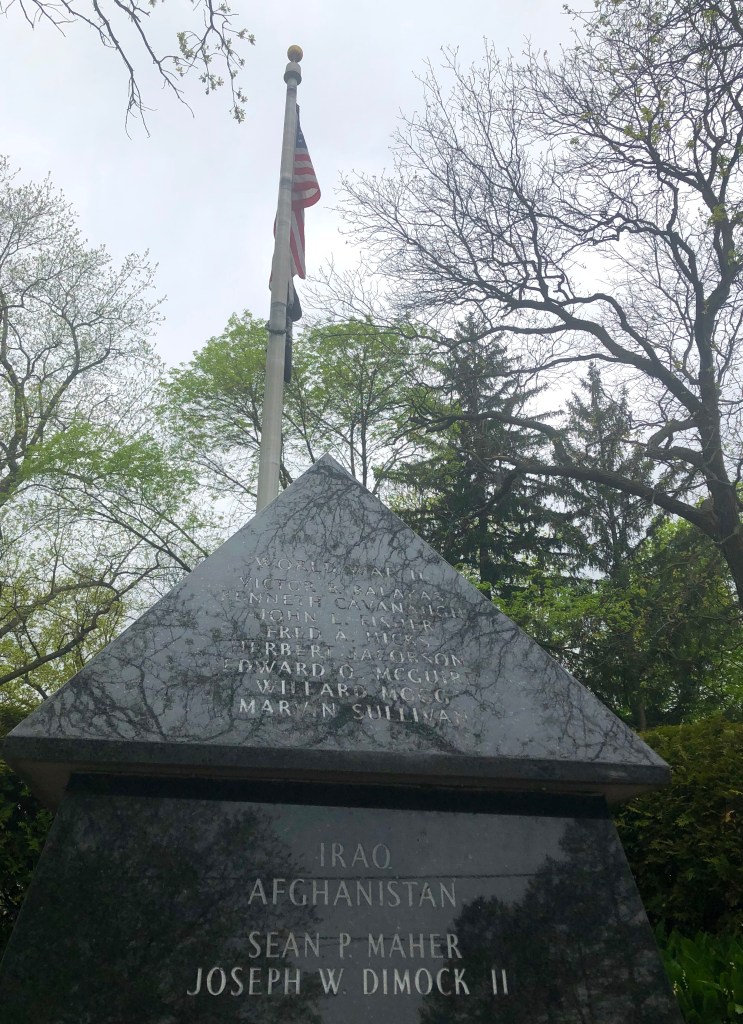
I love Grayslake. For me, it is hometown USA. I live a few blocks from Center Street and can walk downtown to enjoy the shops, bars, restaurants, and community events I also live a block or two away from Memorial Park, a small park that contains small monument with the names of Grayslake residents who died in our wars, from World War I to present. I walk by the monument frequently. Memorial Park is also where Grayslake’s Memorial Day parade ends and where we host our Memorial Day ceremony. We are having one tomorrow and I will be marching with the Veterans of Foreign Wars and the American Legion.
I have several fond memories of our parade. I marched in it with my kids as members of the YMCA Indian Guides and Indian Princesses Programs. I enjoyed coffee, donuts, and at least one beer in a neighbor’s driveway as a spectator. I always attend the ceremony following the parade. As a Marine Corps veteran, skipping it would be sacrilege. I took the ceremonies seriously. I stood at attention during the national anthem and removed my hat. I remained silent and reflective during the speeches. I noticed people who do not. I also noticed the people who attended the parade but skipped the ceremony. I judged them all unfavorably. For several years, I did this somewhat superficially because Memorial Day was an idea.
That superficiality changed about ten years ago when the parents of Sean Maher were honored during our ceremony. Sean, a nineteen-year-old Marine, was killed during an ambush in Iraq in 2005. While I did not know Sean or his parents. I became overwhelmed with sadness. I am a reserved and stoic person. I could not control my sadness. I cried in public. As you can tell, I am now having difficulty controlling my emotions. That day continues to be one of the saddest of my life and I think about the Mahers every Memorial Day and other days too.
Following the 9/11 attacks, I suspect Sean saw clear purpose in service and a more urgent need to serve. According to the Chicago Tribune, he enlisted in 2003 as soon as he turned 18 and as the US began its invasion of Iraq. He started boot camp two months after graduating from high school. Sean’s war was once called the Global War on Terror. What could be a more noble cause?
I once considered death in the military as an occupational risk. I knew people who had died, mostly people who attended the Naval Academy or Marine training with me. While I mourned their deaths, I did not have the same sadness that I felt for Sean. Those other deaths were personal to me in the sense that I related to them from my own point of view. In my younger days, I was theoretically prepared to die in service. I projected this willingness on others and rationalized that they died doing what they loved – sad but understandable and noble.
Sean’s death was different for me. Sean was not my age; he was much younger. I could not imagine him as a peer. As a father of two, I could only imagine him as a son. I mourned his death from an imagined perspective of his parents. His loss felt unbearable to me, a total stranger. His death did not seem understandable or noble. It seemed tragic. I cannot imagine how it felt to his parents. How could they continue with life after suffering such a loss? I do not know but suspect they are enduring it one day at a time. Parents of dead warriors have had to do so for generations.
The United States had been at war in the Middle East for more than 20 years. While we have not had another 9/11, I do not think that security has been worth the price. We have spent trillions of dollars, lost thousands of lives, while tens of thousands of veterans live with debilitating physical and mental injuries. It is also likely that our young men and women have killed hundreds of thousands in our service. Associated conflicts created millions of refugees and displaced people. I do not think we improved anything in the Middle East.
Many people fault George W. Bush. Certainly, the buck stops with the Commander-in-Chief, and I do blame him and his advisors. I blame Congress. The House and Senate voted to authorize the war in Iraq. In the Senate, 58% of Democrats voted for the authorization. It was a bipartisan mistake. I blame myself and I blame the general population, because most people supported the invasion of Iraq. Politicians eventually do what the people want, though their public relations machines are also designed to influence / manipulate our opinions.
While I criticized Bush, the errors continued with successive administrations. Obama prematurely reduced forces in Iraq, which led to the rise of ISIS and elements of the war in Syria with its associated refugee crisis. Trump negotiated troop withdrawal with the Taliban, which seemed to ensure their eventual takeover. Oddly, this was one of the few Trump policies honored by Biden who was also in charge during the disastrous and humiliating withdrawal from Afghanistan. More important than the loss of national prestige is the abandonment of Afghan people who helped us and are certain to be persecuted or worse by the Taliban. If you are following the news, mandatory burkas are back, and women’s rights are returning to pre-war Taliban rules. What was the point?
The purpose of Memorial Day is to honor those who died in service to our country. Yes, we should honor those who died for our country even if the wars they fought were misguided and mismanaged.
As I tell the story about the death of Sean Maher and reflect on the thousands of others who lost their lives in the service of our country, I cannot ignore the unnecessary and tragic loss of life that Americans inflict on other Americans at home.
In the span of a couple of weeks, our country is dealing with the impact of more rampage shootings with nineteen children killed in Texas. If you have seen their pictures, you know they were all sweet little children. Like my experience with Sean’s parents, there is no way I could face the parents of those kids. It’s too tragic. Why would somebody want to kill them and their teachers? It’s also difficult to understand how anyone could kill people they do not even know based strictly on the color of their skin as happened to ten people in Buffalo. I say it’s hard to understand, but killing people based on their race or religion has been going on for centuries. How can we accept the constant flow of deaths by gang violence in our cities that kills both gang members and bystanders? I think about Max Lewis, the twenty year old University of Chicago student who was struck by a stray bullet while sitting on a green line train. I highlight Max only because his mother is a friend of my sister-in-law. For that reason, he is not a faceless name like so many of the victims of seemingly routine murders that we constantly hear about. Let’s not forget deaths of despair: about 46,000 suicides in 2020; and overdoses now at an annual rate of about 100,000. All of this points to an illness in our culture.
Something needs to change.
Many seem to blame the rise of violence on the easy availability of guns and especially the easy availability of assault weapons and other guns with high capacity magazines. It’s obvious that if the recent perpetrators could not get guns, then the recent rampages would not have happened like they did. My wife points to the experience in the United Kingdom and Australia where significant restriction in gun access ended mass shootings. However, I am sympathetic to the counter argument that people are the ones that use the guns and that guns can be tools of violent, evil, or mentally ill people. This is why you will not hear me use the term “Gun Violence.”
Others are calling for what I will call enhanced school security measures and expansion of gun rights as a means of protection against evil people. While I bet that I am more pro-gun than you are, this seems absurd.
Some people think the rise in inner city shootings are the result of more passive policing following the George Floyd murder and associated protests and riots.
Peggy Noonan, the Wall Street Journal commentator, reposted an article that she wrote in 1999 following another school shooting, which sounded like it could have been written yesterday. I think there is something to her argument that we live in a culture of death. Certainly, media in all forms is complicit in this. Violence is an integral part of news – if it bleeds it leads. Movies and video games are full of violent imagery. Advances in technology make violence appear realistic on screens. I am trying to avoid violent movies. When I fail, I am shocked by routine and realistic gore displayed. Here is what Noonan said in an interview in the 1990’s: “Violence is an inspiration to the unstable. People who are frailer, less stable, are more subject to the dark images they see. Teenagers, who are by nature in greater thrall to sweeps of emotion and sadness, are most vulnerable.” Her antidote: Faith, a belief in a loving god is the solution to a culture of death especially for troubled souls.
Over decades public mental health services have been hollowed out. People also think we could be facing a mental health crisis throughout the country. If so, we do not have the infrastructure needed to deal with it.
After these shootings I turn to a book called Tribe by Sebastian Junger, published in 2016. For me it’s a fascinating read because he contrasts life in American Indian tribes versus life in Western culture with a focus on the difficulties faced by war veterans as they re-integrate to society. In my words, the book is about our culture of disconnection, which has only grown since he wrote the book with advances in social media and the forced isolation from the recent pandemic. One of his points is that as our nation’s affluence has increased, we have become more isolated and less dependent on each other. In an Indian tribe, the culture was more unified, more accountable, and more interdependent. Native people had to live, work, fight, and suffer together with a common purpose – just like Americans deployed to a war zone. Here is how he describes the culture that veterans return to:
“It’s hard to know how to live for a country that regularly tears itself apart along every possible ethnic and demographic boundary. The income gap between rich and poor continues to widen, many people live in racially segregated communities, the elderly are mostly sequestered from public life, and rampage shootings happen so regularly that they only remain in the news cycle for a day or two. To make matters worse, politicians occasionally accuse rivals of deliberately trying to harm their own country – a charge so destructive to group unity that most past societies would probably have just punished it as a form of treason. Its complete madness and veterans know this. In combat soldiers all but ignore differences in of race, religion, and politics within their platoon. It’s no wonder many of them get so depressed when they come home.”
Sebastian Junger
I bet you have other issues with our culture.
Junger asserts that the last time we experienced unity was in the aftermath of 9/11. The same unity that sent us to a twenty year war, also had positive effects. His stats: no rampage shootings for two years. In New York City, there was a 20% reduction in suicides in the six months after the attacks and a drop in murder rate by 40%. People have the capacity to come together when faced with mutual purpose. He provides other examples where national hardship brought people together like during the bombings of Great Britain during World War II and the during crisis in Bosnia. My wife and I look back fondly when a microburst hit our neighborhood, knocked down trees, and cut off energy for three days. All the neighbors pitched in to help each other. We could not escape to the internet or television. It felt great as we all connected more deeply with each other.
What’s to be done?
I am not sure but know that in the aftermath there are calls for changes from many directions. While there are varying merits to the different arguments about causes and actions, we seem have very little data on what works. (Note: Following my presentation, one of our congregants commented that she had issues with this statement because the Brady Bill’s assault weapons ban reduced violence. I stand by this statement based on this FactCheck.org article. However, I admittedly ignored this argument because I do not see assault weapons bans as being politically viable. Republican positions are firmly against them, and Democrats remember losing the House in 1994 somewhat due to their votes for the assault weapons. I am happy to be wrong.)
I found a few interesting tidbits in a 2018 article from Regulatory Review, a publication that does not sound too partisan to me. The author makes the case that we know very little about how increased gun regulation will impact death.
Certainly, you know that the one of the negative side effects of the typical post shooting uproar is that people rush to buy more guns likely due to security concerns or a fear that the regulations will tighten availability. According to the article, there is data that that correlates the spike in gun purchases following the Sandy Hook shootings with increases in homicides and accidental deaths. This data supports the argument more guns equal more death.
Waiting periods for pistol purchases is known to reduce suicides rates by 5%.
Outside the realm of gun laws, the author identifies other actions that might be beneficial:
- Summer job programs reduce mortality by up to 20% for participants
- Cognitive behavioral therapy for at risk youth has been shown to decrease violent crime arrests by 45-50% of participants.
- Repeal of duty to warn laws for mental health providers, could reduce teen suicides by 8% and decrease homicides by 5% because patients may be more honest during counseling sessions.
- Eliminating teen curfews could reduce urban gunfire by two thirds. You may have seen that because of downtown violence, Chicago is tightening teen curfews. I hope more recent data justifies Chicago’s decisions. Call me cynical but I have often come to expect government action in Illinois to be counterproductive. I am afraid that violence in Chicago is going to get worse before it gets better, though that has nothing to do with the curfew decisions.
Surprisingly, she seems to argue that the energy and political futility spent in pushing for gun regulations may prevent us from pursuing other interventions that will reduce the impact of violence. I am afraid that she is right because I cannot see an area where the country is more divided than on gun regulations and law enforcement, though it could be a toss-up with the pending Roe decision.
As individuals, what should we do?
I encourage you to use the democratic process to push for whatever change you think will work. Relative to legal changes, I think the best you can hope for expansion of mandatory background checks and raising the age to purchase guns to twenty-one. Neither seems like a radical assault on Second Amendment rights. I think it would be a positive result if troubled eighteen year-old’s were not be able to buy assault rifles. However, I cannot see how these changes will reduce inner city violence and inner cities are where most murders occur. You do not know if you do not try, and any lives saved will probably be worth it.
While I support some enhanced regulations, I think that cultural improvements are what is really needed. We cannot legislate those changes. We can only model them.
Sadly, we are a nation divided and a nation that seems to yell more than listen. We alienate rather than persuade. On this Memorial Day weekend let’s take a little break from the yelling and take the time to remember our heroes who died in the service of our country like Sean Maher.
Let’s work to honor their lives by embracing the responsibility of citizenship and creating a nation worthy of their sacrifice. I think Lincoln said it best at the end of his Gettysburg Address:
“…It is for us the living, rather, to be dedicated here to the unfinished work which they who fought here have thus far so nobly advanced. It is rather for us to be here dedicated to the great task remaining before us—that from these honored dead we take increased devotion to that cause for which they gave the last full measure of devotion—that we here highly resolve that these dead shall not have died in vain—that this nation, under God, shall have a new birth of freedom—and that government of the people, by the people, for the people, shall not perish from the earth.”
Abraham Lincoln
I believe in the principles upon which the United States was founded. I believe freedom is not free and that freedom occasionally demands service and sacrifice. We have foreign rivals. At some point we may need to call on our children to fight and die on our behalf. However, I believe the more urgent calling is to restore unity, cohesion, and peace at home. By peace I mean less literal shooting as well as less figurative violence, like hate in our hearts and hate in our thoughts.
What if God was one of us? What if God was all of us? How would we treat each other?
I think our Unitarian Universalist faith provides a good map. While it might be kind of trite, in words attributed to Gandhi, I think the best we can do is to “be the change we want to see.”
I want to end with the message I always want to hear in church: Lets commit to loving ourselves, loving our neighbors, and loving our enemies. Let’s help each other. Let’s forgive ourselves and each other. If you believe, love God as you define him, her, or they. Thank you.
Closing Reading:
John 15: 9-16 (New International Version)
As the Father has loved me, so have I loved you. Now remain in my love.
If you keep my commands, you will remain in my love, just as I have kept my Father’s commands and remain in his love.
I have told you this so that my joy may be in you and that your joy may be complete.
My command is this: Love each other as I have loved you.
Greater love has no one than this: to lay down one’s life for one’s friends.
You are my friends if you do what I command.
I no longer call you servants, because a servant does not know his master’s business. Instead, I have called you friends, for everything that I learned from my Father I have made known to you.
You did not choose me, but I chose you and appointed you so that you might go and bear fruit—fruit that will last—and so that whatever you ask in my name the Father will give you.
This is my command: Love each other.


 Why is Thad Glad?
Leave a comment